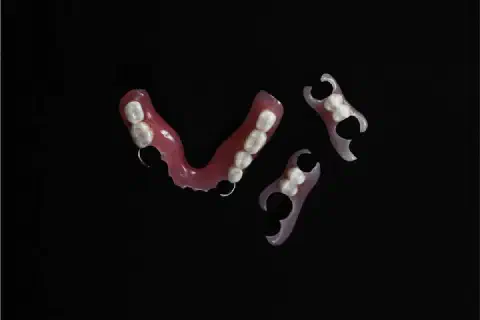

If you are missing one or more teeth and are not ready for implants or a bridge, an acrylic partial denture is the quickest and most affordable way to fill the gap.
At Alta Loma Dental Care in Rancho Cucamonga we often use acrylic partials as a first step: they restore your smile and chewing while you heal from extractions, save for a longer-lasting restoration or plan for implants. This guide covers what they are, what they cost, how they compare with other partials and how to care for them. For an overview of every type, see our dentures and partial dentures page.
What are acrylic partial dentures?
Acrylic partial dentures, sometimes called removable partial dentures or “flippers”, are made from dental acrylic resin (PMMA) with a gum-colored base and replacement teeth. Wire or acrylic clasps hook around your remaining natural teeth to hold the partial in place. Because there is no cast framework, they can be fabricated quickly, sometimes within a day or two, and they are simple to adjust.
They are a good fit for:
- Temporary tooth replacement while an extraction site heals
- Budget-conscious patients
- Patients waiting for dental implants to integrate
Pros and cons of acrylic partial dentures
| Pros | Cons |
|---|---|
| Most affordable partial ($599–$1,200) | Bulkier than cast metal or flexible partials |
| Fast fabrication | Lasts 3–5 years and needs periodic relines |
| Easy to adjust, repair and add teeth to | Can fracture if dropped |
| Natural gum-colored appearance | Clasps may be visible in some cases |
| Improves chewing and speech | Must be removed nightly for cleaning |
Acrylic vs. cast metal vs. flexible partial dentures
| Type | Typical cost | Comfort | Durability | Appearance | Best for |
|---|---|---|---|---|---|
| Acrylic partial | $599–$1,200 | Good | 3–5 years | Good | Temporary and budget cases |
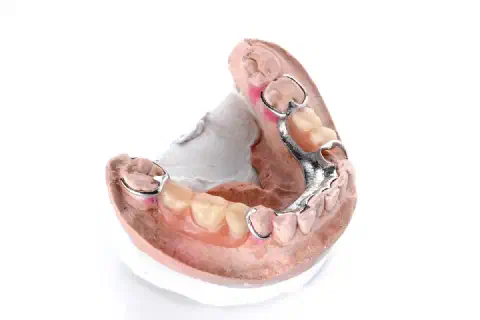
| Cast metal partial (cobalt-chrome) | $1,500–$2,500 | Excellent | 10+ years | Slimmer design, small metal clasps | Long-term use |
| Flexible partial (nylon) | $999–$1,800 | Best | 5–8 years | No visible metal clasps | High esthetic demands |
Many patients choose an acrylic partial first and upgrade later once healing is complete or their budget allows. Dental insurance often covers about 50% of a partial denture up to your annual maximum. These are typical ranges; your written estimate depends on the exam, X-rays and your insurance.
What to expect
- Consultation. Dr. Lee examines your remaining teeth and gums, takes X-rays and confirms an acrylic partial is appropriate.
- Impressions and shade selection. We record the shape of your arch and match the tooth color to your natural teeth.
- Delivery. The partial is fitted and the clasps adjusted. Expect a week or two of adaptation while you get used to speaking and eating with it.
- Follow-up. We fine-tune any sore spots and check the fit at your regular visits.
Caring for an acrylic partial
- Remove and rinse it after meals.
- Brush it daily with a soft brush and denture cleaner; toothpaste is too abrasive.
- Soak it overnight in water or denture solution, and never in hot water, which can warp acrylic.
- Brush your gums, tongue and palate every morning, and brush and floss your natural teeth carefully around the clasps.
- Handle it over a towel or a sink of water; acrylic can crack if dropped.
- Keep your regular checkups so we can reline the partial as your gums change.
Ready to fill the gap?
Call Alta Loma Dental Care at (909) 987-6268 or book online to find out whether an acrylic partial, a cast metal or flexible partial, a bridge or implants is the right choice for you. Our office is at 7283 Carnelian St, Rancho Cucamonga, CA 91701.
Prices mentioned on this page are typical ranges for planning purposes only. Your written estimate depends on the exam, X-rays and your insurance benefits, and we confirm costs with you before any treatment begins.