

Every strong smile has a story of repair. Whether it is a small cavity or a more complex restoration, Dr. Lee delivers gentle, modern and natural-looking solutions that bring your teeth back to full health. Every treatment is planned around your tooth’s condition to balance comfort, durability and appearance.
Not sure which option fits your situation? Book a consultation and we will walk you through it.

What Are Fillings & Dental Restorations?
Fillings and dental restorations both repair damaged teeth, but they serve different purposes.
- A filling is a quick, direct treatment that repairs small cavities, chips or cracks in a single visit.
- A dental restoration is a broader category that includes fillings as well as inlays, onlays, crowns and bridges—anything that rebuilds or replaces part of a tooth.
Simply put, a filling fixes minor damage, while a restoration rebuilds what has been lost. If you want to understand how cavities form in the first place, start with our guide to tooth decay stages and symptoms.
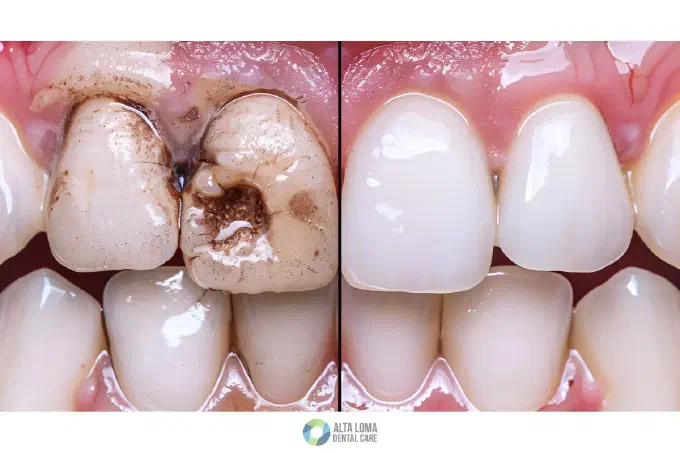
When Does a Tooth Need a Filling or a Restoration?
A filling is best for small problems: cavities, tiny chips or early decay. It restores strength and stops the problem from spreading.
If a tooth is more seriously damaged—cracked, missing a large section, or treated with a root canal—it may need a restoration such as an onlay or crown to protect it fully.
An easy way to think about it:
- If the damage covers less than half the tooth, a filling usually works.
- If it affects more than half, an onlay or crown is the safer, longer-lasting option.
Many patients also choose to replace old metal fillings with tooth-colored restorations that look natural and keep their smiles strong.
Filling Materials: Composite vs. Amalgam vs. Porcelain
The material we recommend depends on the size and location of the cavity, how much chewing force the tooth takes, your budget and how visible the tooth is when you smile.
Composite (tooth-colored) fillings
Composite is our most common choice. It is a blend of resin and fine glass particles that is shade-matched to your tooth and bonded directly to the enamel. Patients choose composite because it:
- Looks natural—virtually invisible when you talk or laugh
- Bonds to the tooth, which supports the remaining structure and requires less drilling than a metal filling
- Contains no mercury
- Works for small to medium cavities in both front and back teeth
Composite fillings typically last 7–10 years and often longer with good home care. One thing to know: composite does not lighten with teeth whitening, so if you are planning to whiten, do it first and we will match the filling to your new shade.
Amalgam (silver) fillings
Amalgam is a metal alloy that has been used for more than a century. It is very durable under heavy chewing, tolerates moisture during placement and costs less, which still makes it a reasonable option for some large back-tooth cavities. The trade-offs are its silver color and the extra tooth structure that must be removed to hold it in place. Read more in our guide to amalgam fillings.
Porcelain (ceramic) inlays and onlays
When a cavity is too large for a filling but the tooth does not need a full crown, a porcelain inlay or onlay is custom-made to fit the prepared tooth and bonded in place. Porcelain is highly stain-resistant, closely mimics enamel and typically lasts 10–20 years. It costs more and usually takes two visits. Learn when we recommend them in Porcelain Inlays and Onlays: When a Filling Isn’t Enough.
At a glance
| Feature | Composite | Amalgam (silver) | Porcelain inlay/onlay |
|---|---|---|---|
| Appearance | Tooth-colored | Silver / gray | Tooth-colored, stain-resistant |
| Typical lifespan | 7–10+ years | 10–15+ years | 10–20 years |
| Relative cost | Moderate | Lower | Higher |
| Tooth preservation | Excellent (bonded) | Moderate | Excellent |
| Best for | Small–medium cavities | Large back-tooth cavities | Large cavities, cracked teeth |
We also use glass ionomer for some small fillings and root-surface cavities (it releases fluoride), and gold remains an option for patients who want maximum durability.
Our Dental Restoration Options
Tooth fillings (composite or glass ionomer) Ideal for small cavities or chips; completed in one visit with materials that blend with your smile.
Inlays and onlays For moderate damage that needs more support than a filling but less coverage than a crown. Read about porcelain inlays and onlays.
Crowns and bridges Crowns fully cover weakened teeth, while bridges replace missing ones. Explore crowns and bridges.
Dental implants For missing teeth, implants replace the root and crown for the most natural function. Learn about dental implants.
The Procedure: What to Expect
Before treatment Your visit starts with an exam and X-rays to assess the tooth. We discuss your options and help you choose the right restoration.
During treatment For a composite filling, the visit usually takes 30–60 minutes per tooth:
- Numbing – Local anesthetic keeps you comfortable throughout.
- Decay removal – The decayed portion is gently removed, leaving a clean surface.
- Bonding – A bonding solution prepares the tooth so the composite adheres securely.
- Layering and shaping – Composite is placed in thin layers, each hardened with a curing light.
- Polishing and bite check – The filling is shaped and polished to match your enamel, and we check your bite so it feels natural.
Inlays, onlays and crowns may be completed the same day with our CEREC technology, or over two visits when a lab-made restoration is the better choice.
Aftercare Mild sensitivity to hot or cold is normal for a few days. Wait until the numbness wears off before chewing, and keep up with brushing, flossing and routine checkups. Our dental filling aftercare guide covers the first 24 hours and beyond.
When to Replace a Filling
Fillings wear over time, just like natural teeth. Schedule an exam if you notice:
- Sensitivity to hot, cold or sweets around a filled tooth
- Visible cracks, chips or wear
- A dark line at the edge of the filling
- A rough spot you can feel with your tongue, or floss that catches
We check existing fillings at every routine visit and can usually replace a worn filling in a single appointment.
Cost of Fillings and Restorations
The cost of your treatment depends on the type, size and complexity of the restoration. On average:
- Fillings: $150–$350 per tooth
- Inlays/onlays: $600–$1,200
- Crowns: $800–$2,000
- Dental implants: $3,000–$5,000 per implant
These are typical ranges; your written estimate depends on the exam, X-rays and your insurance. Most insurance plans cover part of these treatments—often a large share of the cost of a filling—and we verify your benefits and explain any out-of-pocket costs before treatment begins. Treating a small cavity now costs far less than the root canal or crown a neglected cavity can eventually require.
Why Choose Alta Loma Dental Care for Fillings and Restorations
Dr. Lee combines years of experience with technology like CEREC same-day restorations and digital scans to deliver precise, natural-looking results. Every treatment is personalized to your smile, and we take the time to explain your options and costs so you can decide with confidence.
Want to avoid future fillings? Our guide to preventing tooth decay covers the daily habits and preventive treatments that matter most, and regular exams and cleanings catch small problems before they need bigger repairs.
Call (909) 987-6268 or book online. We see patients Monday through Friday, 9 AM to 5 PM, at 7283 Carnelian St, Rancho Cucamonga.
Note: This article is for informational purposes only and does not substitute professional dental advice. Always consult with a qualified dental professional for personalized recommendations.
Prices mentioned on this page are typical ranges for planning purposes only. Your written estimate depends on the exam, X-rays and your insurance benefits, and we confirm costs with you before any treatment begins.
Guides & resources
- Why Teeth Aren’t Bones & Why It Matters for Tooth Decay
- Prevent Cavities and Tooth Decay with Simple Tips That Work
- Porcelain Inlays and Onlays: When a Filling Isn't Enough
- Dental Filling Aftercare: What to Expect and How to Heal
- Rotten Teeth: Causes, Treatment and Prevention
- Amalgam Fillings: Safety, Lifespan, Pros and Cons
- Tooth Decay and Cavities: Stages, Symptoms, Treatment