

Restore and Protect Your Smile with Crowns and Bridges
At Alta Loma Dental Care, we understand how frustrating it is to live with missing or damaged teeth. Our crowns and bridges are designed to bring back a full, confident smile so you can speak, chew and laugh comfortably again. Whether you need to protect a weakened tooth or replace one or more missing teeth, Dr. Lee offers customized restorations right here in your neighborhood.
We are conveniently located at 7283 Carnelian St, Rancho Cucamonga, CA 91701, just minutes from Alta Loma, Etiwanda and Upland. Call us at (909) 987-6268 to schedule a consultation.
What Are Dental Crowns and Bridges?
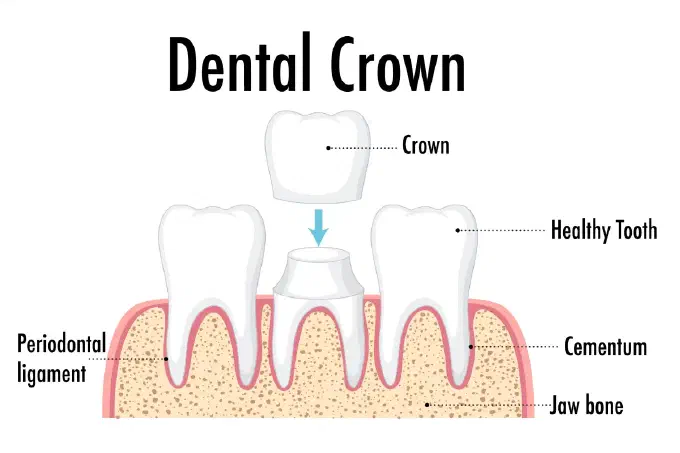
Dental crown: A crown (sometimes called a cap) protects and strengthens a tooth that has been weakened by decay, fracture, a large filling or root canal treatment. It fits over the prepared tooth, restoring its shape, size and function.
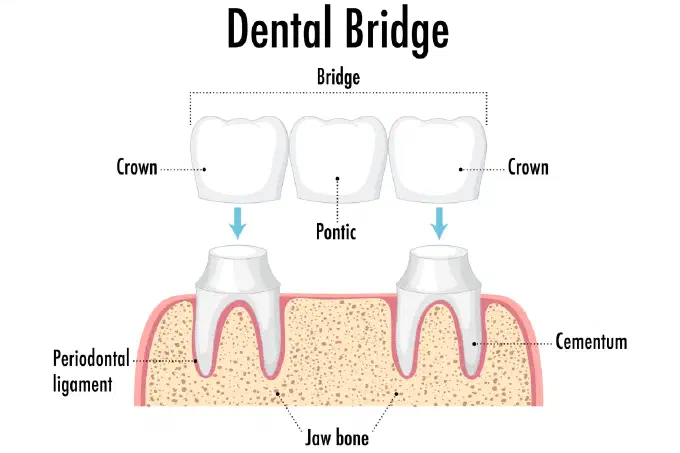
Dental bridge: A fixed bridge replaces one or more missing teeth. Artificial teeth (pontics) are anchored to crowns on the neighboring teeth (abutments) or to implants, bridging the gap and keeping the remaining teeth from drifting.
Both restorations are cemented in place and are not removed for cleaning, which gives them stable, long-term function.
Types of Crowns We Provide
We tailor the material to the location of the tooth, the forces it takes and your aesthetic goals:
- All-ceramic / porcelain crowns — metal-free and the most natural-looking; excellent for front teeth
- Zirconia crowns — extremely strong and still tooth-colored; a great choice for back teeth
- Porcelain-fused-to-metal (PFM) — a time-tested option with added strength for posterior teeth
- Gold alloy — the longest-lasting option and gentle on opposing teeth
- Same-day CEREC crowns — designed, milled and bonded in a single visit for eligible teeth; see our same-day crowns page
Types of Dental Bridges
- Traditional bridge — crowns on the teeth on each side of the gap with a pontic in between; the most common option
- Cantilever bridge — used when only one adjacent tooth is available to support the pontic
- Maryland bridge — a conservative design with a metal or porcelain framework bonded to the back of the neighboring teeth
- Implant-supported bridge — anchored by dental implants rather than natural teeth; ideal for several missing teeth in a row or when the adjacent teeth are not strong enough to serve as anchors
Who Is a Good Candidate?
A crown is usually recommended when a tooth is cracked, heavily filled, worn or has had a root canal, and there is enough healthy tooth structure left to hold it.
A bridge is a good choice when you are missing one or more teeth in a row and the teeth on either side are healthy enough to support crowns, or when those teeth already need crowns anyway. Healthy gums and bone are important for both restorations. If you are missing several teeth or want to avoid reshaping healthy neighbors, an implant-supported option may be better. Dr. Lee checks your teeth, gums and jawbone at your consultation and walks you through the options.
The Crowns and Bridges Process: What to Expect
1. Consultation and evaluation
We begin with a comprehensive exam, X-rays and a discussion of your goals, and confirm whether a crown, bridge, implant or another option is best.
2. Preparation and impressions
To make room for the restoration, the affected teeth are reshaped under local anesthetic. A digital or physical impression is taken to model your crown or bridge.
3. Temporary crown or bridge
You leave with a temporary restoration that protects the prepared teeth while the final one is made.
4. Fabrication
Our dental lab, or in-office CEREC milling for eligible crowns, fabricates your custom restoration.
5. Fitting and cementation
About one to two weeks later you return for final placement. We check the fit, color, bite and appearance before bonding the restoration securely.
6. Follow-up and care
We schedule a follow-up to make sure everything is comfortable. Most patients experience only mild sensitivity for a few days.
Cost and Insurance Information
Every case is unique, so the cost depends on the number of teeth involved, the materials, the complexity and whether implants are needed.
| Restoration | Typical range |
|---|---|
| Crown (any material) | $1,000–$2,000 per tooth |
| Bridge | $2,000–$5,000, depending on the number of pontics |
These are typical ranges; your written estimate depends on the exam, X-rays and your insurance.
We accept a variety of dental PPO insurance plans, and most plans cover 50 to 80 percent of crowns and bridges when they are medically necessary. Flexible payment plans through Cherry are available. Call (909) 987-6268 or bring your insurance details to your consultation and we will help you navigate coverage.
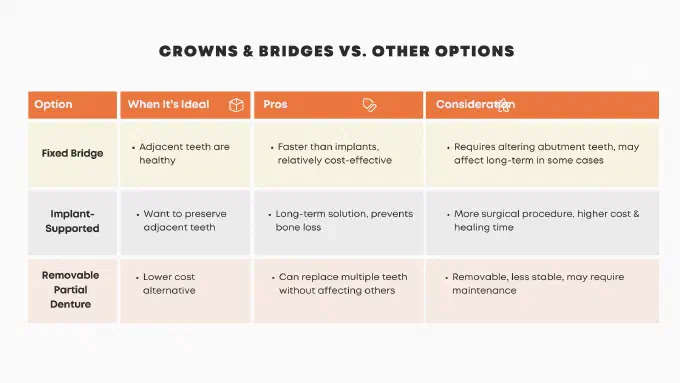
We will walk you through the options during your consultation so you can choose confidently.
Caring for Your Crowns and Bridges
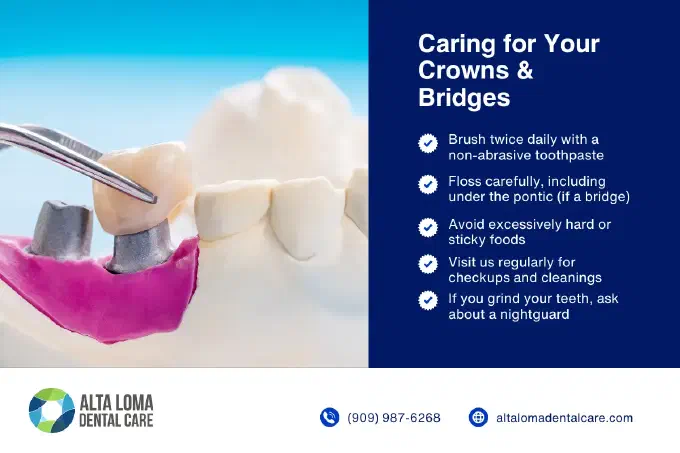
Proper care extends the life of your restoration:
- Brush twice daily with fluoride toothpaste, paying attention to the gumline where the crown meets the tooth
- Floss every day; use a floss threader, Superfloss or a water flosser to clean under a bridge
- Avoid chewing ice, hard candy, popcorn kernels and sticky sweets that can crack or loosen a restoration
- Quit smoking to prevent staining and gum problems around the restoration
- Wear a nightguard if you grind your teeth
- Keep your checkups and cleanings every six months so we can check the fit and the margins
For a complete routine, read our guide to caring for dental crowns and bridges. If a crown or bridge ever feels loose or comes off, save it and call us; a loose restoration is one of the problems we treat as a same-day emergency.
Why Choose Alta Loma Dental Care for Restorative Care
- Local, trusted practice serving Rancho Cucamonga and nearby Alta Loma, Etiwanda, Upland and Fontana
- Advanced technology: digital impressions, in-office CEREC milling and modern lab partnerships for comfort, precision and turnaround time
- Customized treatment planning: your needs, budget and smile goals guide which restoration is best
- Comfort-focused care: local anesthetic and pain-management options to keep you comfortable
Ready to restore your smile? Call (909) 987-6268 or request your appointment online.
Note: This article is for informational purposes only and does not substitute professional dental advice. Always consult with a qualified dental professional for personalized recommendations.
Prices mentioned on this page are typical ranges for planning purposes only. Your written estimate depends on the exam, X-rays and your insurance benefits, and we confirm costs with you before any treatment begins.