
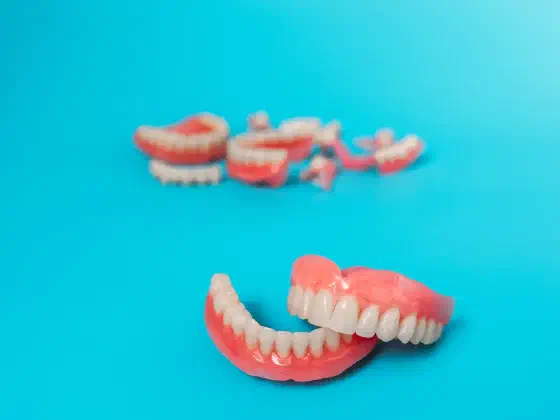
Missing several teeth, or all of them, affects far more than your smile: chewing, speech, nutrition and the shape of your face all change when teeth are gone.
Dentures remain one of the most practical, affordable ways to replace them. At Alta Loma Dental Care in Rancho Cucamonga, Dr. Sidney Lee designs custom full dentures, partial dentures and implant-supported dentures, and helps you choose the option that fits your mouth, your priorities and your budget. This page explains the types, what the process involves, typical costs and how to care for your dentures once you have them.
What are dentures?
Dentures are removable, custom-made replacements for missing teeth and the gum tissue around them. The teeth are set in a gum-colored base that rests on your gums and, in the case of partial dentures, clasps onto your remaining natural teeth. Bases are usually acrylic; partial dentures may also use a cast metal framework or a flexible nylon material. Today’s dentures are shaped and shaded to look natural and are fitted from precise impressions of your mouth.
Full, partial and implant-supported dentures
Full dentures replace every tooth in the upper or lower arch. An upper denture covers the palate and stays in place mainly by suction; a lower denture rests on the ridge and is held by the cheeks and tongue. Full dentures come in two forms:
- Conventional dentures are made after the gums have healed from any extractions, which gives the most predictable fit.
- Immediate dentures are made in advance and placed the same day teeth are removed, so you are never without teeth. They are relined once the gums settle.
Partial dentures are for patients who still have healthy natural teeth. The partial fills the gaps, restores chewing and keeps the remaining teeth from drifting. A fixed alternative for one to a few missing teeth is a dental bridge, which does not come out.
Implant-supported dentures snap onto two or more dental implants placed in the jaw. They do not slip, allow much stronger chewing and help preserve bone. Implants can support either a full arch or a partial. Read our guide to implant-supported dentures to see whether you are a candidate.
Types of partial dentures
Partial dentures differ mainly in the material of the base and clasps. Each has trade-offs in cost, comfort, durability and appearance:
| Type | Typical cost | Durability | Comfort and appearance | Best for |
|---|---|---|---|---|
| Acrylic partial | $599–$1,200 | 3–5 years | Bulkier; clasps may show | Temporary and budget cases |
| Cast metal partial | $1,500–$2,500 | 10+ years | Thin, precise fit; small metal clasps | Long-term use |
| Flexible partial | $999–$1,800 | 5–8 years | Lightweight; gum-colored clasps, no metal | High esthetic demands, metal sensitivity |
Many patients begin with an acrylic partial while healing or saving for something more permanent, then move to a cast metal or flexible partial, a bridge or implants. Each linked guide covers that material’s pros, cons and care in detail.
The denture process
- Consultation and exam. Dr. Lee evaluates your remaining teeth, gums and bone, takes X-rays and discusses full, partial and implant-supported options with a written estimate.
- Preparation. Any teeth that cannot be saved are extracted, and any remaining teeth that will hold clasps may be reshaped slightly. Implants are placed at this stage if you have chosen an implant-supported denture.
- Impressions and records. Precise impressions and a bite record are sent to the dental laboratory.
- Try-in. You preview the teeth set in wax so the shade, shape and bite can be adjusted before the denture is finished.
- Delivery and adjustments. The finished denture is fitted, and over the following weeks we smooth any pressure points as your mouth adapts.
Conventional dentures take a few weeks from impressions to delivery; immediate dentures are placed the day of your extractions.
How much do dentures cost?
| Type | Typical range |
|---|---|
| Full dentures | $1,000–$8,000 per arch, depending on materials (basic to premium) |
| Partial dentures | $599–$2,500, depending on material (acrylic, cast metal or flexible) |
| Implant-supported dentures | $8,000–$30,000+ per arch, including the implants |
Cost depends on the materials, the number of teeth replaced and whether extractions or implants are needed. Dental insurance often covers about 50% of dentures up to your annual maximum; we verify benefits before treatment and offer payment plans through Cherry. These are typical ranges; your written estimate depends on the exam, X-rays and your insurance.
Caring for your dentures
- Clean them daily. Rinse after meals and brush with a soft brush and a denture cleaner. Toothpaste is too abrasive.
- Soak overnight. Keep them in water or a denture solution so the material does not dry out or warp; avoid hot water.
- Care for your mouth too. Brush your gums, tongue and palate every morning, and brush and floss any remaining natural teeth, especially around clasps.
- Handle with care. Clean them over a folded towel or a sink of water; dropped dentures can crack.
- Keep your checkups. Regular exams let us check the fit, reline when needed and look after the health of your gums and any remaining teeth.
Adjusting to new dentures
The first two to four weeks take patience. Expect some soreness, extra saliva and a little difficulty with speech and chewing. Read aloud to speed up speech adaptation, start with soft foods cut into small pieces, and chew slowly on both sides at once. Sore spots are normal early on and are fixed with a quick adjustment; call us rather than waiting for your next visit. Over time your gums and bone change shape, so dentures that once fit well may loosen. A reline restores the fit, and after 5–8 years most conventional dentures are ready to be remade.
Schedule a denture consultation
Whether you are considering dentures for the first time or your current set no longer fits, call Alta Loma Dental Care at (909) 987-6268 or request an appointment online. We are located at 7283 Carnelian St, Rancho Cucamonga, CA 91701, and we accept most dental insurance plans.
Prices mentioned on this page are typical ranges for planning purposes only. Your written estimate depends on the exam, X-rays and your insurance benefits, and we confirm costs with you before any treatment begins.